

Men’s testosterone levels gradually decrease from age 35 with research suggesting the rate declines as much as 1% per year. ¹⁻²
Other contributing factors to lower testosterone besides the natural aging process include a body-mass-index (BMI) over 27, doing less than 75 minutes per week of vigorous exercise, and smoking.³
Since testosterone levels in men influence health markers such as vitality, sexual health, and quality of life, consumer interest has rapidly grown. According to Google Trends data comparing the week of February 21st, 2021, to the week of February 22nd, 2026, there has been more than a 42% increase in searches for “low testosterone”.⁴
The global testosterone booster supplement market was valued at $3.82bn in 2025 and has been projected to reach a staggering $10.32bn by 2035, which is expected to be achieved by a CAGR of 10.45%.⁵ North America currently represents the largest market globally, with a 41% market share in 2025.⁵
The key type of products in the market that led 2025 were herbal-based testosterone boosters.⁵ Greater access to at-home saliva and blood testing has improved visibility into male hormonal status, a dynamic that parallels growing interest in the testosterone-support category.
Historically popular ingredients currently available on the market for supporting testosterone levels include options such as fenugreek, ashwagandha, and tongkat ali. However, with an abundance of products already on the market with these ingredients, it has become increasingly difficult for brands to launch finished products for men’s health with a unique story and sufficient points of differentiation.
New solution for testosterone support
Vidya (Bunnell, FL), a leading manufacturer of herbal extracts and probiotics, recently studied a new solution to support men’s total and free testosterone levels. The findings led to the release of Alliàge™, a proprietary aged garlic extract that utilizes a process to facilitate the conversion of allicin into the antioxidant S-allylcysteine (SAC).
Interestingly, historical records indicate garlic may have been one of the first performance enhancing ingredients, used by athletes in some of the first Olympics in Greece.⁶ In Ancient Rome, troops and sailors also consumed garlic for strength.⁶ While this historical context is notable, Vidya’s research team proceeded to design a clinical trial to evaluate its relevance in a modern setting.
“With Vidya’s recent launch of an ingredient for women’s hormonal health, it was only natural for us to aim to provide support for men’s hormonal health as well,” says Steve Geiger, vice president of sales & operations for Vidya’s North America division.
Clinically-validated testosterone support
Continuing Vidya’s tireless dedication to develop robust substantiation for each proprietary ingredient launch, the company recently completed a human clinical trial demonstrating how the ingredient could be readily applied in the men’s health space. The research and development efforts supporting the new extract’s creation were led by the company’s R&D center in Bangalore, India. The center is led by the company’s founder, Shyamprasad Kodimule.
The double-blind, randomized, placebo-controlled trial included 52 men ages 25 to 60 years with symptoms of reduced testosterone, as determined by the Aging Males’ Symptoms (AMS) scale as well as less than optimal erectile function, which was measured by the International Index of Erectile Function (IIEF). Subjects consumed one capsule after dinner containing either 200mg of Alliàge or a capsule with only maltodextrin as a matching placebo for 60 days.
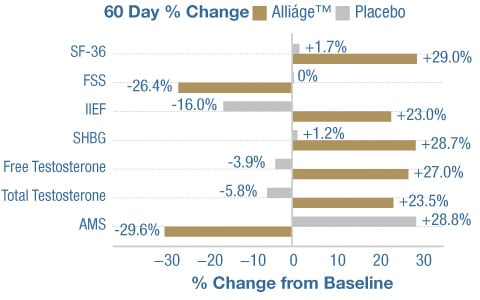
Results indicated a statistically significant improvement in both the AMS score and the IIEF score in the Alliàge group as compared to the placebo (p < 0.05). Furthermore, there was a significant improvement in the Fatigue Severity Scale (FSS) in comparison to the placebo (p < 0.05).
Even health-related quality of life improved in comparison to the placebo as measured by the 36-Item Short Form Survey (SF-36) (p < 0.05). The study also confirmed the safety of Alliàge, with no adverse events reported during the trial, and no notable changes in clinical chemistry observed as well.
These benefits may in part be explained by the positive impact of Alliàge on the hormonal profile, with those in the Alliàge group experiencing both a significant increase in free and total testosterone in comparison to the placebo (p < 0.05).
The researchers hypothesized that since there were no significant changes in dehydroepiandrosterone (DHEA) in comparison to the placebo (p > 0.05), it is more likely that Alliàge may promote higher testosterone levels by nature of supporting gonadal steroidogenesis rather than through adrenal hormone production. Preclinical research dating back to 2017 supported the idea that aged garlic extract could play a role in testicular function.⁷
While the study has only just been completed, the company already plans to evaluate more opportunities to conduct research on Alliàge to dive deeper into how these hormonal impacts can improve the daily lives of male consumers seeking to take a proactive attitude to their testosterone levels.
“Vidya takes a science-forward approach to ingredient development, both before and after the ingredient’s debut to the public,” adds Christopher Bailey, Ph.D., director of technical business development at Vidya. “We know the scientific story behind Alliage is just getting started.”
References
- Handelsman, D J.; et al. Age-specific population centiles for androgen status in men. European Journal of Endocrinology. 2015; 173( 6): 809–817.
- NHS. The ‘male menopause’.
- Harvard health publishing. Several factors may cause testosterone levels to drop.
- Google Trends.
- Precedence research. What is the Testosterone Booster Supplements Market Size in 2026?
- Rivlin, R.S.; et al. Historical perspective on the use of garlic. The Journal of Nutrition. 2001; 131(3): 951S-954S.
- Nasr, A.Y.; et al. The impact of aged garlic extract on adriamycin-induced testicular changes in adult male Wistar rats. Acta Histochemica. 2017; 119(6): 648-662.


