


Sarcopenia – age-related loss of skeletal muscle, mass, strength, and function – is a condition which affects 10% to 16% of the elderly worldwide.
Physical inactivity, poor nutrition, smoking, unusual sleep patterns, and diabetes are key factors increasing the risk of sarcopenia. These risk factors create a cycle: inactivity leads to increased muscle loss which can in turn worsen sleep and appetite, further impacting muscle health.
Research shows that the onset of muscle atrophy can be as early as 25 to 30 years of age, further accelerating with age.1 The gradual loss of muscle size contributes to reductions in strength and function at the whole muscle level, which has debilitating consequences for older adults.
Due to loss of muscle, sarcopenia is associated with impaired physical function and a reduced ability to perform daily activities, often leading to increased instances of falls, fractures, hospitalizations, and loss of independence. After age 50, muscle strength declines two to three times faster than muscle mass if left untreated, making strength loss the primary driver of functional impairment in aging.
Loss of skeletal muscle size and function with aging (sarcopenia) may be related, in part, to an age-related muscle protein synthesis impairment. Aging muscles can become anabolically resistant to normal protein doses, often needing higher and faster amino acid signals, specifically a higher leucine threshold, to effectively trigger muscle protein synthesis (MPS).2
MPS is a metabolic process where the body repairs, maintains, and builds new muscle tissue by assembling amino acids into skeletal muscle proteins – vital for preventing muscle wasting in aging populations.
A leucine-sensitive, underserved epidemic
Leucine is widely considered to be a cornerstone amino acid for combating sarcopenia due to its ability to stimulate MPS. In fact, leucine requirements in the elderly are higher than previously suspected – almost double previous recommendations in men. However, leucine’s effectiveness on its own can be limited.
A 2022 study showed isolated leucine supplementation, without protein or other nutrients, did not improve muscle mass and strength in the elderly.3 To combat this, supplementation with two bonded leucine molecules (L-leucyl-L-leucine monohydrate or dileucine) can help to improve the effectiveness of leucine.
In the form of a dipeptide, leucine is transported into the intestinal endothelium via PEPT1. This pathway allows for faster and more efficient absorption, improving the amount of leucine available to drive MPS.
Older adults require more protein to counteract muscle loss and overcome anabolic resistance, but often have the lowest desire or ability to eat it. Dileucine is a promising, low-volume, and efficient way to trigger this muscle-building response without forcing elderly people to consumer large amounts of protein.
A powerful di-peptide solution
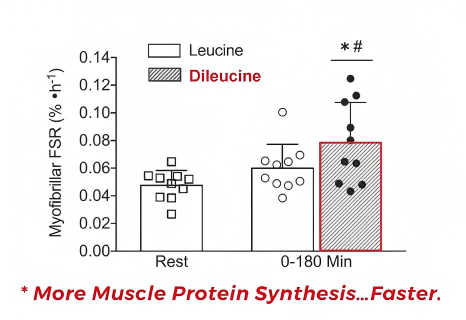
A 2021 study investigated the effects of dileucine and leucine ingestion on postprandial muscle protein turnover.4 Ten healthy men aged between (23 ± 3 years) consumed either 2g of leucine or 2g of dileucine in a randomized crossover design. Participants underwent repeated blood and muscle biopsy sampling during primed continuous infusions of L-[ring-13C6]phenylalanine and L-[15N]phenylalanine to determine MPS and mixed muscle protein breakdown (MPB) rates, respectively.
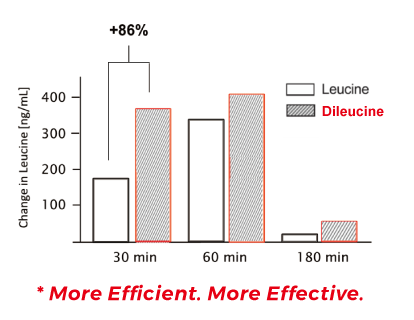
Results showed that dileucine significantly increased free leucine plasma levels, in addition to ensuring intact delivery. After 30 minutes, dileucine delivered 86% more leucine into the muscle (intramuscular) in comparison to ingesting the same amount of leucine.
“Dileucine does not simply raise circulating leucine levels more rapidly, it accelerates delivery to the primary target tissue, skeletal muscle. In addition to increasing leucine availability in plasma, dileucine is partially absorbed intact,” says Dr. Ralf Jaegar, FISSN, CISSN, MBA and co-founder of ING2.
“Strikingly, ingestion of free leucine also led to the formation of dileucine, albeit to a significantly lesser extent than direct dileucine supplementation. The fact that the body actively expends energy to synthesize dileucine from leucine strongly suggests that dileucine serves an important and previously unknown role in human physiology.
“Most strikingly, at the 30-minute mark, dileucine delivered 86% more leucine directly into the target tissue, the muscle (intramuscular), compared with ingesting the same amount of free leucine, highlighting both faster uptake and superior muscle targeting,” adds Dr. Jaegar.
A 2024 study aimed to explore Dileucine’s impact on resistance training outcomes. Using a randomized, double-blind, placebo-controlled approach, 34 resistance-trained males (aged 28.3 ± 5.9 years) consumed 2g of either dileucine or placebo while following a 4-day per/week resistance training program for 10 weeks.
After 0 and 10 weeks, the study analysed changes in body composition, 1-repetition maximum (1RM) and repetitions to failure (RTF) for leg press and bench press, anaerobic capacity, countermovement jump, and maximal voluntary contraction.
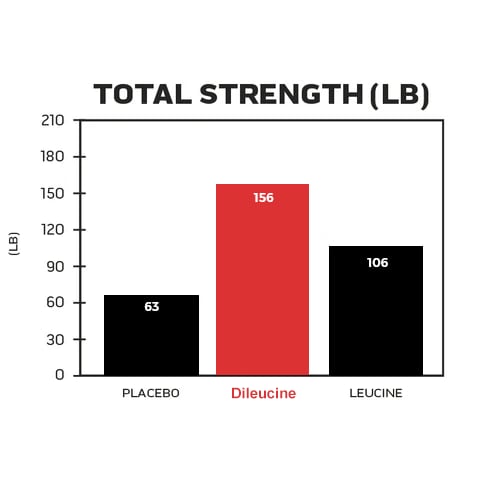
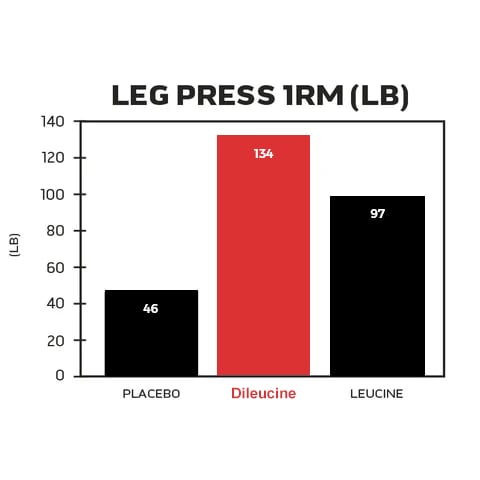
Results showed dileucine supplementation at 2g per/day enhanced lower body strength and muscular endurance in resistance-trained males more effectively than leucine and placebo. In fact, Dileucine increased leg press strength by +23.2% in comparison placebo (+7.3%) and leucine (+15.2%).
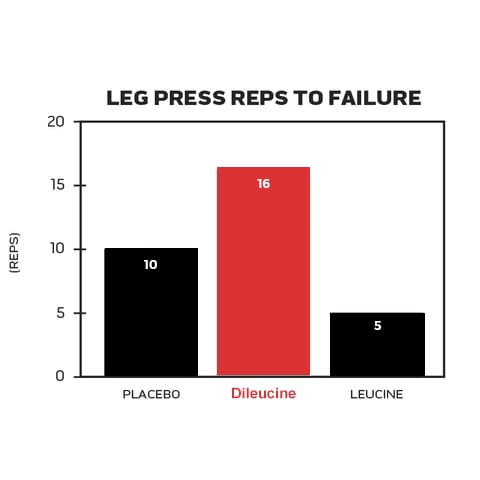
In addition, participants who supplemented with dileucine were able to perform 15 more leg press repetitions after 10 weeks of supplementation while participants consuming leucine performed 5 more repetitions and placebo completed 10 more repetitions. These findings suggest dileucine is potentially effective for improving adaptations to resistance training.
“These results provide intriguing evidence to suggest that supplementation with dileucine over a 10-week period while following a challenging resistance training program can help people gain more strength and experience greater improvements in their muscular endurance when compared to supplementing with leucine or a placebo,” says Chad Kerksick, PhD, professor, exercise science; director, exercise and performance nutrition laboratory at Lindenwood University.
Translating results to target sarcopenia
So, if all research data is focused on young men, how does this relate to seniors struggling with sarcopenia? Both young and senior individuals rely on leucine–mTORC1–MPS as the core anabolic pathway; aging just shifts the threshold as older populations require a bigger, faster leucine signal.
Dileucine in young men demonstrates: superior intramuscular leucine availability vs leucine; higher MPS at rest independent of exercise; and greater strength and endurance gains over 8 weeks of resistance training vs leucine and placebo. In older adults, the same direction of effect is expected to be at least as impactful, because:
- Reduced gut absorption efficiency and blood flow favors dipeptides that use high-capacity PEPT1.5
- Anabolic resistance is partly due to lower amino acids availability at the muscle – dileucine directly addresses this constraint.6
When it comes to muscle health, it is important to ensure supplementation is strong enough to work in a younger population as it is typically more difficult to raise testosterone and gain muscle. Therefore, if dileucine is effective in younger men, results are expected to translate in older populations.
A combined, synergistic multi-nutrient strategy
Although clinical data on dileucine in older adults are not yet available, its rapid and targeted delivery of leucine to skeletal muscle positions it as a compelling primer of MPS within multi-nutrient strategies.
One particularly promising combination is dileucine with β-hydroxy-β-methylbutyrate (HMB), a bioactive leucine metabolite with clinical evidence supporting its ability to attenuate MPB – especially during aging, immobilization, or catabolic stress.
In this context, dileucine may serve to robustly initiate MPS via efficient leucine delivery and mTOR signaling, while HMB helps preserve existing muscle by reducing MPB, addressing both sides of muscle protein turnover.
Beyond HMB, dileucine may also integrate effectively with creatine, which has well-established benefits for strength, training adaptations, and muscle mass accretion when combined with resistance exercise, or with nitric-oxide-promoting ingredients such as citrulline to enhance muscle perfusion and nutrient delivery.
Collectively, these combinations highlight dileucine’s potential role as a next-generation MPS ingredient that can be layered strategically with complementary nutrients to support muscle health across different physiological needs and life stages.
“Dileucine functions as a rapid and efficient trigger of muscle protein synthesis and strength gains, complementing established ingredients that primarily target muscle protein breakdown, training adaptations, or enhanced blood flow to working muscle,” says Dr. Jaegar.
Maintaining quality of life in older years
Maintaining good muscle health as we age is vital for independence, preventing falls, and managing chronic diseases. And as sarcopenia slows mobility and increases frailty, it is important to find proactive solutions which prevent its undesirable effects.
“Sarcopenia isn’t a protein problem. It’s a signaling and delivery problem. Aging muscle doesn’t fail because it lacks amino acids, it fails because it no longer receives a strong enough anabolic message,” says Shawn Wells, co-founder and chief scientific officer at NNB Nutrition.
“Dileucine was designed to solve that exact bottleneck by delivering leucine in a form the body actually prioritizes. This marks a shift away from simply adding more nutrition (in this case, leucine) and toward engineering smarter biology for quality of life as we age.”
Find out more about how dileucine is positioned as ideal support for sarcopenia.
References
- Lexell, J.; et al. What is the cause of the ageing atrophy? Total number, size and proportion of different fiber types studied in whole vastus lateralis muscle from 15- to 83-year-old men. J Neurol Sci. 1988;84(2–3):275–94.
- Moore, D R.; et al. Keeping Older Muscle “Young” through Dietary Protein and Physical Activity. Advances in Nutrition. 2014; 5(5): 599S - 607S.
- Guo, Y.; et al. The Effect of Leucine Supplementation on Sarcopenia-Related Measures in Older Adults: A Systematic Review and Meta-Analysis of 17 Randomized Controlled Trials. Front Nutr. 2022 Jul 1;9:929891.
- Paulussen, KJM.; et al. Dileucine ingestion is more effective than leucine in stimulating muscle protein turnover in young males: a double blind randomized controlled trial. J Appl Physiol (1985). 2021 Sep 1;131(3):1111-1122.
- McColl, T J.; et al. Exploring the multifactorial causes and therapeutic strategies for anabolic resistance in sarcopenia: A systems modeling study. bioRxiv 2025;675977.
- Campbell, W W.; et al. Nutritional Interventions: Dietary Protein Needs and Influences on Skeletal Muscle of Older Adults. The Journals of Gerontology. 2023; 78: 67-72.


