


The Estonian firm created the report to clarify sensory performance—flavour, aftertaste, mouthfeel, sediment risk—as well as the novel food status of its most popular extracts, to support formulation journeys.
“Functional mushroom demand is projected to grow strongly across Europe through 2030; manufacturers need clarity and confidence—not hype,” said Robin Gurney, director of Musheez.
Gurney noted that the functional mushroom market is growing quickly, with the European market projected to reach $19 million by 2030 following a 11.4% CAGR (Grand View Horizon 2025), with particular growth in the functional food and drink space of late.
“We noted a marked increase in enquiries for extract powders for food and drink applications in 2025, including, notably, RTDs, such as lion’s mane carbonated drinks. This means we have had to ‘up our game’ in terms of providing better specification data our clients need for evaluating good fit extracts.”
Poorly directed extract selection causes expensive mistakes, he said.
“This report exists to make extract selection and qualification more predictable by reducing early-stage formulation failures, post-launch reformulation, procurement friction, and reputational risk.”

The firm commissioned a trained sensory analysis panel TFTAK to conduct evaluations of six extracts—reishi, shiitake, maitake, lion’s mane, lion’s mane, soluble lion’s mane—using standardised preparation methods and quantitative scoring.
They used water extract powder for all extracts, plus two extra extracts—1:1 extract powder and water extract powder with maltodextrin—for lion’s mane, as this variety is widely used in food and drink applications.
The report translates the TFTAK results into practical product development guidance for food and drink manufacturers.
It offers further guidance related to processing factors, such as heat, pH, shear and storage, which can change flavour, colour and stability.
Sensory discoveries
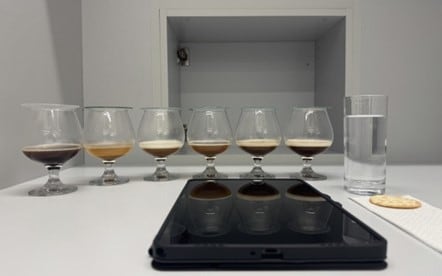
It reveals maitake water extract powder has the strongest sour and salty intensities, giving it greatest alignment with savoury innovations.
Reishi had “the most challenging sensory profile”, with a bitter or burnt flavour, a lot of fine sediment and a coffee-like appearance which Gurney suggested gave it good potential for use in bitters or tonics.
Shiitake was described with strong culinary cues, such as beef stock, supporting savoury base potential.
“Maitake drives more than shows the strongest umami, sour and salty cues, which can shift balance if the matrix isn’t designed for it. But the same time can produce some interesting taste experiences.”
Lions mane water extract powder with maltodextrin had minimal sediment relative to other Lion’s Mane samples making it best suited for beverage formats.
“Solubility is a common pain point in real drinks,” said Gurney. “Beverage success typically depends on rapid dispersion with minimal sediment and stable appearance, not just whether some fraction dissolves in water.”
Lion’s mane 1:1 extract was the mildest overall, which could indicate broad usage opportunities.
However, Gurney warned that ‘mild’ doesn’t automatically mean ‘easy’ in foods where appearance and mouthfeel are also important.
He explained that, for food applications, water extracts are a pragmatic starting point in many cases.
“In addition to Novel Food regulation compliance, they typically: Integrate naturally into aqueous food systems, align with consumer expectations of ‘food-like’ processing, support savoury and roasted matrices, provide a “clean” ingredient message option for food and drink brand marketing teams."


