

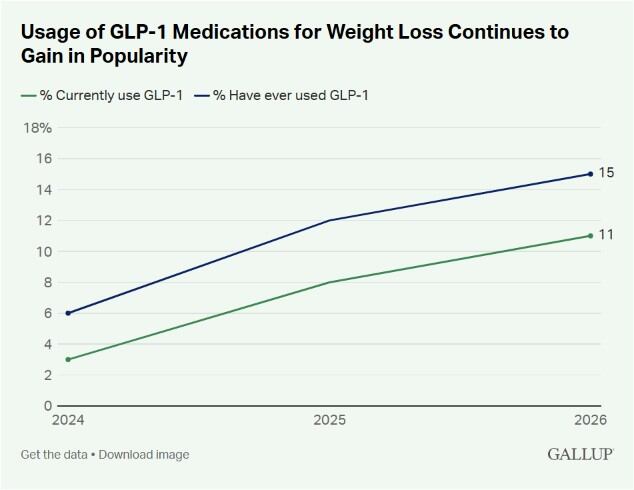
GLP-1 drugs continue to gain traction, with 11% of U.S. adults currently taking the medications for weight loss purposes. Recognizing the opportunity, Nestlé recently outlined its strategy for building a consumer-products business around the nutritional challenges associated with GLP-1 use.
The Swiss food giant’s interest in the GLP-1 consumer is hardly new. In 2024, Nestlé Health Science launched a GLP-1 nutrition platform, offering products and guidance around muscle preservation, gut health, micronutrient intake, hydration, skin and hair health as well as weight rebound management. The platform drew from its own set of supplement brands, including Garden of Life, Boost, Nature’s Bounty, Nuun and Vital Proteins.
Two years later, Nestlé is taking the strategy a step further by targeting some of the nutritional challenges associated with GLP-1 use, using AI to accelerate research, product development and consumer analysis.
“Nestlé isn’t panicking about GLP-1 drugs gutting snack sales — it’s cashing in on the fallout,” Brian Pia, a retired management consultant and former marketing communications executive with more than 200 consumer product launches to his credit, said in a LinkedIn analysis.
Other major players are tapping into the trend, too. Last year biosolutions maker Novonesis and healthcare company Novo Nordisk announced a partnership to study whether microbiome-targeted supplements can enhance the effectiveness of GLP-1 weight-loss medications.
Pia said the strategy reflects a broader shift in how Big Food is approaching GLP-1s, which were initially viewed as a threat to food consumption. Rather than competing with appetite-suppressing medications, companies are treating the nutritional aftereffects of weight loss as a product-development opportunity.
As this new consumer group grows, Big Food, supplement, ingredient and pharma companies are all targeting the nutritional needs around GLP-1 use. The result is a growing tug of war over who will own the emerging “companion” nutrition market.
Supplements planted the flag first
“Historically, the supplement industry has often been the first to identify emerging consumer needs and develop targeted solutions,” said Scott Dicker, senior director of market insights, SPINS. “We saw that with gut health, immune support, personalized nutrition and now GLP-1-related nutritional support.”
He said the convergence signals that GLP-1-related nutrition is evolving from a niche weight-management trend into a broader nutrition and health ecosystem.
“When companies across food, ingredients, supplements, and pharmaceuticals begin investing around the same consumer need state, it’s usually a sign that the opportunity is reaching a new level of maturity,” Dicker said.
While Nestlé’s entry validates the opportunity those brands identified, it also increases competition. Dicker said early supplement brands helped define the consumer challenges associated with GLP-1 medications and created products designed to address them.
He added that the entry of major food and health companies could expand the overall market rather than simply redistribute share. However, Dicker noted that larger players bring greater scale, distribution, consumer reach and R&D capabilities, putting pressure on supplement brands that rely primarily on GLP-1 positioning. Brands with differentiated science, specialized formulations, practitioner credibility or deeper consumer insights may be better equipped to compete as the category matures.
“The real opportunity may be for supplement companies to leverage their agility. They’re often able to innovate faster and respond to emerging consumer needs more quickly than larger organizations.”
Is this actually a new category?
Companies are largely recycling existing nutrition solutions for new consumer groups, Kantha Shelke, PhD, senior lecturer at Johns Hopkins University and principal of Corvus Blue, told NutraIngredients. But GLP-1 users come with new constraints, she said, particularly around reduced food intake and changing food preferences.
“Nutrient density has moved from being a marketing claim to becoming the design scaffolding,” she said.
Protein and muscle preservation have the strongest scientific rationale, Shelke said. GLP-1 drugs suppress appetite, which can lead people to consume less protein and other nutrients as they lose weight. Increasing protein intake can help support lean mass, particularly when paired with resistance training, she said.
But other areas may be more vulnerable to marketing getting ahead of the evidence. Collagen, for example, is being marketed around concerns about skin changes and the so-called “Ozempic face,” but facial fat loss is not the result of a collagen deficiency, Shelke said, adding that there is no evidence that consuming collagen can restore lost facial fat or specifically tighten loose skin.
She said micronutrients and hydration have a more straightforward rationale because consuming less food can mean consuming less of a range of essential nutrients. However, she cautioned that products addressing these needs are not necessarily unique to GLP-1 users.
According to Shelke, the bigger formulation challenge may be sensory. While GLP-1 users may report that foods taste different, she said the issue is less about impaired taste function and more about changes in food preferences and appetite, requiring formulators to rethink products rather than simply mask unwanted flavors.
Shelke said many companies are taking existing products and positioning them around the needs of GLP-1 users rather than fundamentally changing their formulations. “Currently, companies are merely relabeling. Far fewer are reformulating,” she said.
Where to go from here?
Over the longer term, Dicker expects the market to evolve beyond the “GLP-1 companion” label and become integrated into broader wellness and nutrition categories.
“Consumers ultimately shop for benefits, not mechanisms,” he said. “Most people are seeking outcomes such as satiety, healthy weight management, digestive wellness, muscle preservation, metabolic health, and overall nutritional adequacy.”
As a result, Dicker said categories such as protein, fiber, probiotics, hydration and targeted micronutrition could benefit from sustained demand even if the GLP-1 terminology becomes less prominent.
“In many ways, GLP-1 medications may serve as an accelerant for trends that were already gaining momentum across health and wellness,” he said.
For companies looking to capture that demand, however, simply adding GLP-1 messaging to an existing product may not be enough. Shelke said the opportunity will favor brands that use the changing needs of GLP-1 consumers to rethink their formulations rather than simply repositioning existing products.
“Success will belong to the companies reformulating and revising their product offerings for this consumer, rather than merely shuffling, and relabeling for the drug,” she said.
GLP-1 companion nutrition is emerging as a distinct category that is creating a new battleground for food, supplement and ingredient companies as they compete to meet the needs of this growing consumer group.

